This joint open letter signed by over 80 civil society organizations expresses concern regarding the pending expiry of the World Bani’s Climate Change Action Plan and calls for it to be extended pending development of a new Action Plan. The letter also urges the World Bank to strengthen its Paris Agreement alignment process and the quality and transparency of its climate finance provision, to ensure its energy investments are aligned with the I.5°C target and to integrate climate change into the revision of International Finance Corporation (IFC) and Multilateral Investment Guarantee Agency (MIGA) Performance Standards as part of broader due diligence efforts. Weiterlesen
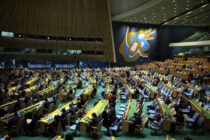
Global: New UN climate accountability resolution an important step in advancing climate justice
Responding to the adoption of the climate accountability resolution at the United Nations General Assembly by overwhelming majority today, Camile Cortez, Senior Campaigner on Climate Justice at Amnesty International, said: Weiterlesen
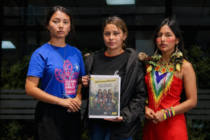
“For frontline Indigenous Peoples, the cost of fossil fuels is not theoretical” – Chief Dsta’hyl on land, climate change and our collective future.
Amnesty International has called on the government of British Columbia to ensure the end of the criminalization of Wet’suwet’en and other Indigenous land defenders. Here, Chief Dsta’hyl reflects on his critical work to protect Wet’suwet’en land, rights and the environment we all depend on. Weiterlesen
“For us, almost everything is at stake”: How students from the Pacific took the fight against climate change to the world’s top court
In 2019, a group of 27 law students from the University of the South Pacific in Vanuatu began campaigning to take the issue of human-induced climate changeand its impacts on human rights to the International Court of Justice (ICJ). Their initiative led the ICJ to issue a landmark Advisory Opinionin July 2025, which made it clear that governments have a legal obligation to protect human rights against climate change. Weiterlesen
Authoritarianism is supercharging the climate crisis
The world’s slide into authoritarian practices is accelerating the climate crisis. At its core, the authoritarian goal is typically to enable resource consolidation for a few. Such projects pursue muscular governance that puts the concerns of these few people ahead of the planet, while weaponising disinformation and dissatisfaction. Weiterlesen
Implications of sea-level rise on human rights
This submission to the Human Rights Advisory Committee highlights the diverse human rights impacts of sea-level rise, with particular reference to the impacts on people living in the low-lying atoll nations of Tuvalu and Kiribati, and in relation to their displacement associated with sea-level rise and climate change more generally. It also shows how similar effects are being experienced around the world, especially people living in small island states or in coastal areas in lower income countries that bear little responsibility for climate change – including in Bangladesh, Fiji, Honduras Pakistan, and Senegal. The submission ends with recommendations to states to avert, minimize and address these impacts. Weiterlesen
The age of fossil fuels must end. Here is how a Fossil Fuel Treaty can help.
Fossil fuels – coal, oil and gas – touch nearly every part of our daily lives, but not without consequences. Their production and use are driving a global climate crisis. The failure of our governments to act, in the face of overwhelming scientific evidence, may well be the biggest intergenerational human rights violation in history. Weiterlesen
How Vanautu’s proposed UN climate change resolution may shift climate accountability for decades
A draft United Nations (UN) resolution on climate change is seeking to turn the International Court of Justice’s (ICJ) Advisory Opinion on states’ obligations concerning the “urgent and existential threat” posed by climate change, into a roadmap for concrete action and accountability. Weiterlesen
Human rights as a compass for transitioning away from fossil fuels in a just, orderly and equitable manner
This submission in response to the UNFCCC COP30 presidency’s invitation argues that a just transition away from fossil fuels must be explicitly anchored in human rights law and principles; the goal of limiting global temperatures to 1.5°C above pre-industrial levels; the “polluter pays” principle; and equity. It must recognize that the climate crisis is, at its core, a human rights crisis whose impacts fall disproportionately on marginalized individuals and groups and thus must be tackled as an issue of climate justice that interrogates the root causes of the climate crisis and how human-induced climate change builds on and magnifies inequalities. Weiterlesen
Trump’s anti-green stance leaves Mozambique at mercy of climate crisis
As Trump tears down renewable energy, once again, Mozambique bears the brunt of climate harm caused by fossil fuel producers. Weiterlesen